FirstThought / Clinical expert discovery
Finding the person
who knows.
- Role
- Founding Member & Product Design Lead
- Period
- 2019–2022
- Product
- ML-powered expert-network platform
- Reach
- 25-person analyst team · 7,500+ expert candidates vetted annually
- Team
- Product Designer · 2 Engineers · Compliance & Partnerships · Head of Research · Business Development
FirstThought brought machine learning to expert discovery for clinical research. We sourced information from ClinicalTrials.gov, PubMed, and other scientific sources. As one of the founding members and the product & design lead, I defined the roadmap and was the sole designer across the product, its identity, and the research operation.
Why I helped start FirstThought.
Nearly a decade designing expert-network and marketplace products at GLG and Axial brought me back to a familiar question: how do you connect someone with a specific need to the right person? FirstThought applied that experience to healthcare and life sciences, where finding relevant expertise meant searching through fragmented clinical and scientific information.
The product problem
An impressive biography only gets a researcher so far. The question is whether this person knows this subject. Clinical trials and publications offered a way to look more closely at that fit.
Manual exploration
Finding the repetitive work
we could automate.
Research Managers were piecing together expert evidence one source and one page at a time. I began with ClinicalTrials.gov to understand that work firsthand and identify which steps were repetitive enough for the product to take on.
I wrote a simple JavaScript scraper, ran it on individual pages, extracted the raw text, and experimented with structuring the fields that could point to a relevant expert.
This manual exploration made the product principle concrete: automate the collection and organization work, while keeping Research Managers in control of the judgment that determines whether an expert is right for a client.
Manual exploration
My technical prototype / Iterate on extraction and structure
- ClinicalTrials.gov
- Visit an individual page
- Run my JavaScript scraper
- Extract raw page text
- Structure useful fields
- Can we identify an expert?
What the prototype exposed
Visiting pages, extracting text, and structuring fields were repeatable tasks that did not need to consume a Research Manager’s attention.
What guided the product
Automate the repetitive work, then present the evidence clearly so Research Managers could focus on expert fit, client context, and judgment.
Product strategy and roadmap
Building the platform
one constraint at a time.
We began with a CRM. The rest of the roadmap followed the work: what was slowing the research team down, and what would help them next? That took us from expert records to discovery, then email and SMS.
1 · Foundation · 2019
CRM

Built the foundation for managing experts and the research operation.
- Expert records
- Research activity
- Outreach tracking
2 · Discovery
Automated discovery

Connected the CRM with our scraper and data-enrichment tooling.
- Clinical and scientific data
- Expert discovery
- Phone-number discovery
3 · Workflow
Email integration

Connected staff email through Microsoft Power Automate.
- Staff communications
- Email workflows
- Operational integration
4 · Engagement
SMS outreach

Twilio for text outreach and automated follow-up replies from our system.
- Multichannel outreach
- Automated follow-up replies
- Less manual work for staff
Why this order?
The team needed somewhere to keep expert records before we could improve how those records were found and filled in. Once discovery improved, another problem came into focus. We could find the right person and still struggle to hear back.
Build around the next constraint
Each phase addressed the next constraint in the research workflow. Integrating email brought staff communications into the operation. Adding SMS extended that workflow to another channel and let the system send follow-up replies automatically, removing a manual task for research staff.
Experience → hypothesis → decision → outcome
Bringing a lesson from patient feedback
to expert outreach.
An earlier lesson proved useful here. At Quality Reviews, I had seen text messages draw stronger responses than email. FirstThought still relied heavily on email, and I wanted to find out whether the same lesson would travel.
We added Twilio so researchers could reach experts by text within the existing workflow. The system also sent follow-up replies automatically, giving staff one less task to handle by hand. After adding SMS, response rates increased 1.5×.
Reconstructed product walkthrough
From a research question
to a consultation-ready expert.
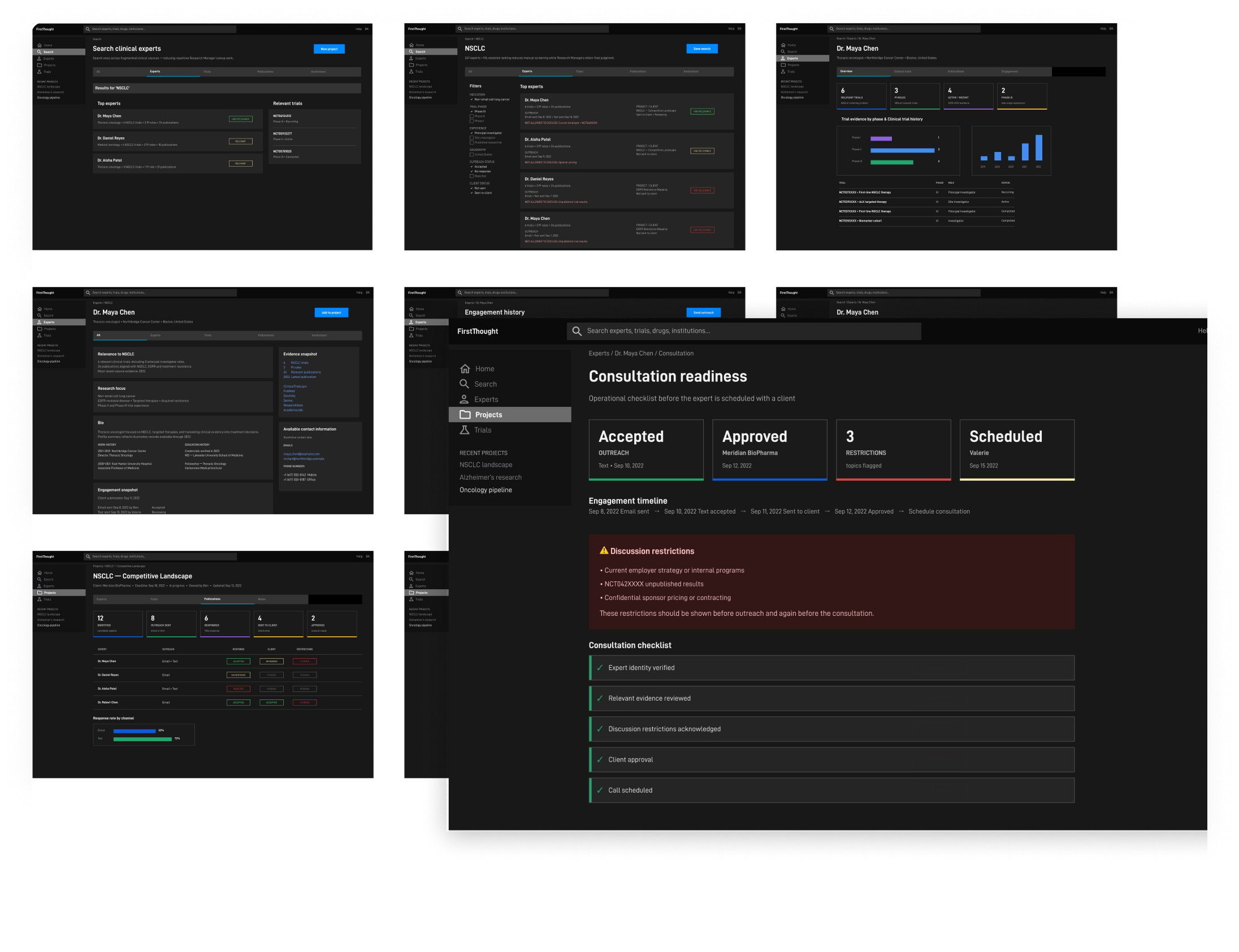
These screens illustrate the research workflow: finding experts, reviewing the evidence behind their relevance, and coordinating outreach and client review.
My role
As one of the founding members and the product & design lead, I defined the roadmap from the initial CRM through automated discovery, enrichment, and multichannel outreach. I was the sole designer, prototyped the initial extraction approach in JavaScript, created the brand and marketing materials, and managed some of the research managers working with the tool.
Working together
I worked as the product designer alongside two engineers, a product manager focused on compliance and partnerships, a head of research, and business development. I led product design and roadmap definition; our engineers built the production system, while the wider team brought research operations, compliance, partnership, and commercial expertise.
Outcome
The product shipped and reduced research from several days to a few hours for a 25-person analyst team. A complementary vetting workflow processed more than 7,500 expert candidates annually, and adding SMS outreach increased response rates 1.5×. The company ultimately expanded faster than its funding could support and ran out of funds.
What I learned
How I learned to build from zero.
I learned how much a small, working experiment can clarify. The scraper gave us evidence to discuss; the roadmap gave us an order in which to act. Working with our PM and two engineers meant making decisions concrete enough to build, then learning from what we had shipped.
As one of the founding members and the sole designer, I also worked across brand, marketing, and research operations. That experience connected my design decisions to the people running the service and the business supporting it. I learned to prioritize the next operational constraint and carry useful lessons across domains—like applying what I had learned about SMS at Quality Reviews to expert outreach.
I also learned that product design includes knowing what technology is available to help. Power Automate gave us a way to connect staff email to the workflow; Twilio let us add text outreach and automate follow-up replies. Understanding those possibilities helped me shape the roadmap and have better conversations with engineering. Part of my responsibility was to look beyond the interface, recognize when an existing service could solve a problem, and work with the team to decide whether it belonged in the product.