Travel insurance / Research & product strategy
The Customer Journey
We Didn’t Own
A flashing Claude logo in a session recording raised a question about where customers were making their decisions—and whether our marketplace would remain part of them.
01 / Observed evidence
The Unexpected Visitor
The visitor arrived, entered their trip information, looked at the insurance quotes, and left.
An unremarkable shopping session, except for one small detail: a flashing Claude logo was visible throughout the flow.
I noticed it while reviewing Hotjar recordings for a travel insurance marketplace. Most sessions offered familiar things to investigate: hesitation, backtracking, the occasional determined encounter with a filter. This one suggested there might be another adviser in the room.
Was the visitor asking Claude to explain the policies? Comparing our results with something elsewhere? Using an assistant to operate the browser?
The recording could not tell me. It showed the logo, not what the tool was doing. There was no proof of autonomous operation, and the session ended without a confirmed purchase.
Still, it changed the question I was asking.
We were working to help customers make decisions on our website. What if an important part of the decision was already happening somewhere else?
What we saw
Observed evidence
- 01Trip information entered
- 02Quote results viewed
- 03Visitor left
Flashing Claude logo visible throughout
Unknown: the tool’s role, who controlled the interaction, and any subsequent purchase.
What we wondered
Strategic hypothesis
- 01Traveler describes needs to AI
- 02AI helps evaluate insurance
- 03Traveler visits a marketplace or insurer to verify and buy
02 / Research & industry context
Following the Evidence
The recording did not arrive in isolation.
Across 25 customer interviews over four years, I had begun hearing travelers describe using AI to help shop for insurance. These conversations suggested behavior worth following. They did not establish how common it was, how well the tools performed, or whether people bought the resulting recommendations.
I also reviewed more than 200 Hotjar recordings. The session with the Claude logo provided a specific observation, with a particularly clear boundary around what remained unknown.
Two Contentsquare CX conferences added a wider perspective. A session on conversational commerce and the agentic future of the customer journey, presented by Vince Koh, helped connect the question to developments beyond insurance. The conference agenda provides context for that discussion.
Each source did a different job.
The interviews described customer behavior. The recordings showed interactions on our site. The conferences offered ideas about where commerce might be heading.
Together, they gave me a reason to investigate. They did not prove that AI was replacing the marketplace.
Research scope, not a measure of AI adoption.
03 / Coverage context / Illustrative scenario
The Trouble with Comparing Insurance
Travel insurance is an awkward thing to compare by price.
Two policies can cost roughly the same and offer materially different protection. The difference may sit in an exclusion, an activity definition, a pre-existing-condition provision, or the circumstances under which an evacuation will be arranged.
The benefit limit is the beginning of the conversation.
NAIC guidance advises travelers to examine policy-specific limits and exclusions, including dangerous activities and pre-existing conditions. It also describes evacuation coverage in relation to reaching medical care, making the destination and conditions of transport worth checking.
Consider a hypothetical $5,000 surf trip to Costa Rica.
A quote form can establish dates, destination, age, and trip cost. Understanding the trip takes a little more conversation:
Two hypothetical $150 policies might answer those questions differently. Those are illustrative prices, not verified quotes or a comparison I conducted.
Finding a lower premium would be useful. Understanding what the premium buys could matter considerably more.
04 / Strategic hypothesis
A Different Kind of Travel Agent
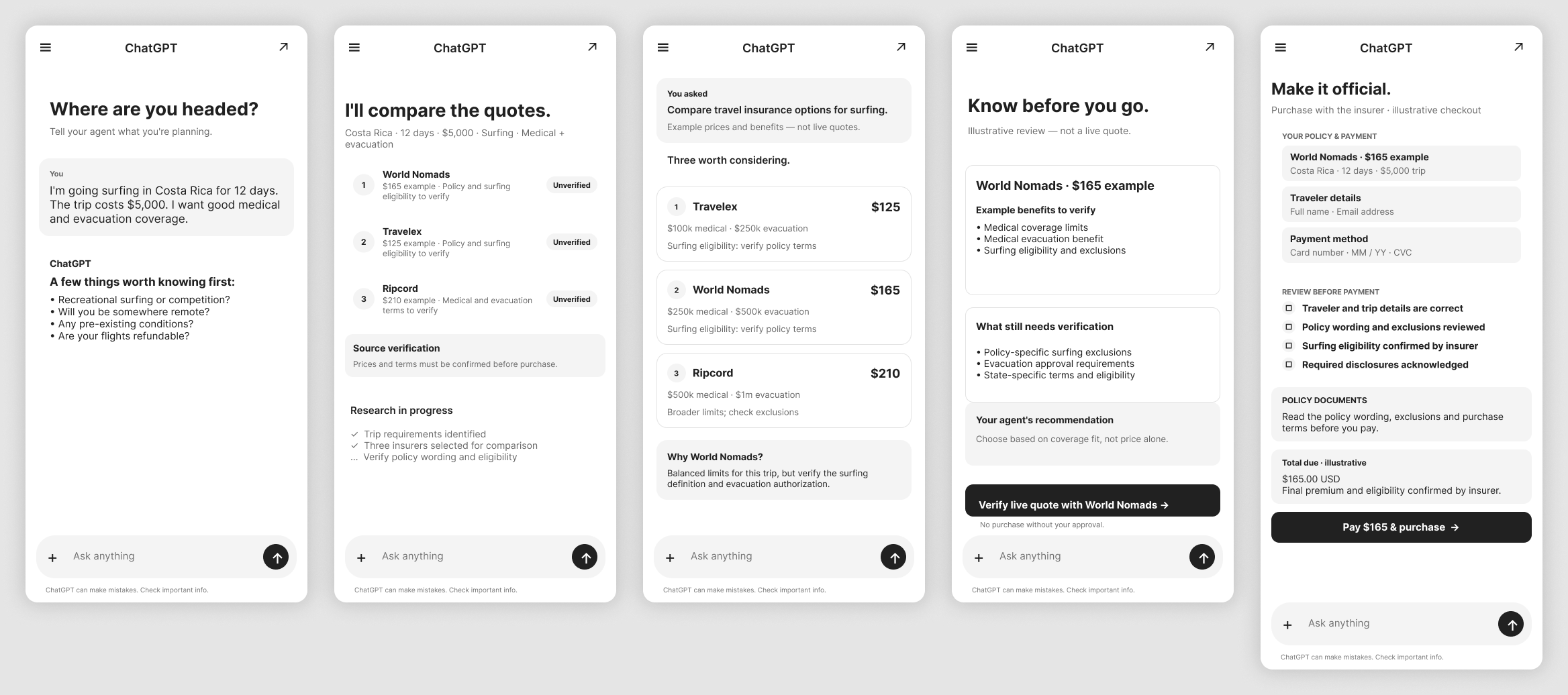
An AI assistant could begin with the trip rather than the form.
It could ask follow-up questions, identify requirements, retrieve applicable policy documents, and explain how particular clauses relate to the traveler’s plans. With reliable integrations, it could also request current quotes and help compare them.
That is the opportunity I would explore. Its accuracy was not demonstrated by this research.
For the surf trip, a useful assistant would connect the traveler’s answers to activity definitions, medical benefits, evacuation conditions, cancellation terms, and exclusions. It would cite the wording, identify uncertainty, and pass unresolved questions to the insurer or licensed seller.
An “adventure” label would not be enough to send anyone confidently into the Pacific.
| Task | AI assistant Potential | Comparison marketplace Established role and limits |
|---|---|---|
| Understand needs | Adaptive questions about the traveler and trip | Structured forms and filters; adviser support varies |
| Compare insurers | Depends on reliable access and integrations | Comparison across participating insurers |
| Interpret policy language | Contextual explanation, requiring verification | Documents, summaries, and human explanations vary |
| Identify exclusions | Could connect planned activities to relevant clauses | Disclosures, filters, and support vary |
| Obtain live quotes | Requires current, authorized quote access | Quotes for supported plans, subject to inputs and eligibility |
| Complete purchase | Requires transactional access, disclosures, and confirmation | Supported checkout or handoff to an insurer or licensed seller |
| Explain complex scenarios | Personalized follow-up, with escalation when uncertain | Self-service guidance and human assistance vary |
| Establish reliability | Traceable sources, applicable terms, and error checks | Accurate disclosures, legitimate sellers, policy terms, and support |
The strongest model to test combines these capabilities: AI for discovery, needs assessment, analysis, and interpretation; comparison sites or insurers for verified live pricing, eligibility, and compliant purchase.
A fluent explanation would still need a dependable policy behind it.
05 / Industry context / Analogy
The Case for Going Direct
Travel booking offers a useful analogy.
A traveler might research options on Booking.com, Orbitz, or Travelocity, then book with the airline or hotel. Loyalty benefits, access to support, and handling changes or cancellations can influence that choice.
There are concrete incentives. Marriott’s loyalty terms, for example, exclude specified third-party rates from points and elite benefits.
Travel + Leisure describes loyalty and support trade-offs between booking channels.
This is industry context, not a finding from the insurance interviews. It does not establish that travelers increasingly distrust aggregators, that direct booking is always preferable, or that insurance customers will follow the same route.
The useful possibility is narrower: the place where someone researches a purchase may be different from the place where they complete it.
AI could make that separation easier. Whether travelers would choose it for insurance remains a question.
06 / Strategic hypothesis
The Business We Didn’t See Coming
A comparison marketplace usually presents itself as a destination: arrive, enter details, compare policies, and buy.
An assistant could rearrange that journey.
If customers begin with AI, the marketplace might supply essential information without becoming the place they visit. Alternatively, the assistant might work directly with insurers.
- Discovery
AI assistant
Understand the trip, surface needs, and frame questions.
- Evaluation
Verified quote & policy providers
Accessed through data or APIs: current prices, eligibility, applicable documents, and evidence for comparison.
- Purchase
Insurer or licensed seller
Confirm details, present required disclosures, complete checkout, and issue the policy.
That possibility raised three strategic questions.
What would distinguish the marketplace?
Coverage clarity, useful comparisons, dependable information, and human judgment could become more valuable as basic summaries become easier to obtain.
What would direct distribution change?
Insurers could become easier to reach through assistants. The marketplace would need to understand why customers still chose its purchase experience and support.
Could the infrastructure become the product?
Trusted quote, policy, eligibility, and transaction services could support decisions made elsewhere. That would be a possible business direction to validate, with questions about demand, permissions, licensing, service responsibilities, and commercial viability.
These were strategic hypotheses. The research did not establish that any particular route would succeed.
07 / Internal outcome
What Happened Next
I shared the research and its implications with the product team.
It was not prioritized because of other priorities.
There was no resulting prototype, shipped feature, or measured business outcome. The work surfaced a question that had not yet become an experiment.
For me, it widened the frame of the design problem. Understanding the customer journey meant looking beyond the pages we could observe—and being precise about what we could not.
08 / Proposed study / Not conducted
The Next Experiment
I would begin by watching travelers who already use AI demonstrate how they shop for insurance.
Then I would compare conventional and AI-assisted shopping across matched trip scenarios, including the Costa Rica surf trip. Task order would be balanced to reduce learning effects, and both marketplace and direct-insurer routes would be included.
An insurance specialist would assess the results against the traveler’s requirements, current authorized quotes, and applicable policy documents.
- Verified quote accuracy
- Whether plan, premium, dates, benefits, inputs, and eligibility match a timestamped authorized quote
- Coverage suitability
- Whether the proposed policy fits the trip, including material gaps
- Exclusion comprehension
- Whether travelers correctly understand relevant activity, evacuation, cancellation, and pre-existing-condition provisions
- User effort
- Time, steps, corrections, interventions, and perceived effort
- Confidence
- Whether confidence corresponds to comprehension and policy suitability
- Checkout completion
- Completion to a test confirmation in a supported sandbox; separately verified policy issuance in a consented live study
A simulated checkout would be reported as simulated. Without a live study, actual purchase completion would remain unknown.
I would also observe channel choice and ask why. Price, familiarity, convenience, support, and coverage clarity could all matter. Trust would be something to investigate, rather than an explanation supplied in advance.
Assessment criteria would be defined before testing. A faster journey with a material coverage error would not count as a better one.
The flashing logo was a small observation. The question it left was larger: if customers bring their own adviser, which parts of the journey will they still need us to provide?